

Updated November 2026
What Anthropic’s education plan includes in 2026, which schools offer it, and how students, teachers and researchers can get Claude.
The short version: Claude for Education is Anthropic’s university-wide plan. A school signs up, and its students, faculty and staff get Claude through school accounts (Anthropic). There is no free Claude Pro for students on their own. You get Claude for Education through your school, and schools such as Stanford and Emory give standard seats free. Learning mode, Claude’s tutor-style setting that asks questions instead of handing over answers, started in the education plan and opened to every Claude user in August 2025; in the Claude app today it lives on as a “learn” skill. Anthropic also runs Claude for Teachers, free for verified US K-12 teachers, and a Team plan for scientists. In our November test, a tutor prompt worked in ChatGPT, Claude, Gemini, Grok and Muse. When the student demanded the answer, only Claude kept tutoring, until one added sentence brought the other four into line. Checked November 7, 2026.
If you’re a student, teacher or university administrator looking at Claude for school, Anthropic has a program for each of you. The main one is Claude for Education, a plan that whole universities buy.
What is Claude for Education?
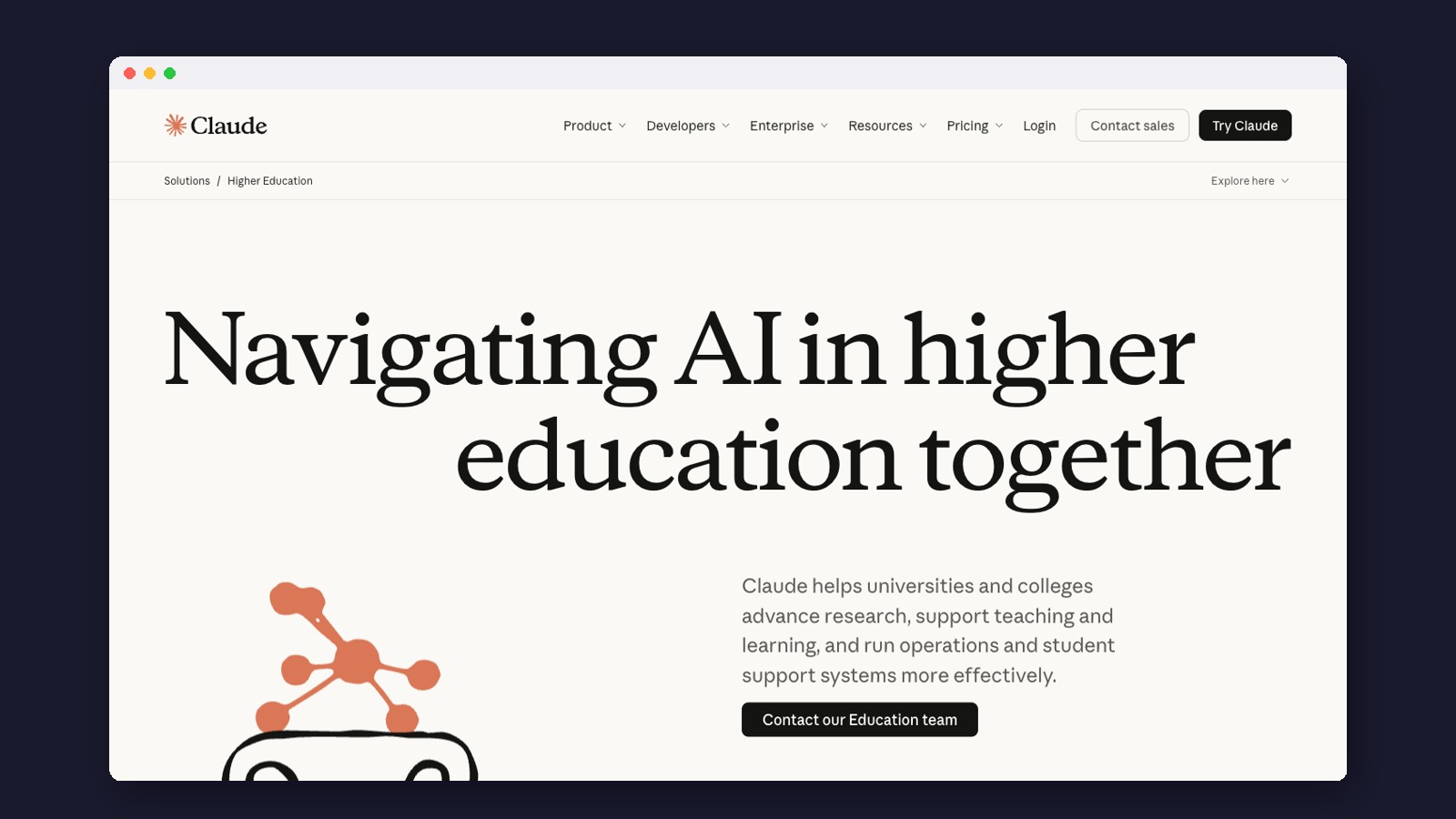
Claude for Education is Anthropic’s plan for colleges and universities, launched in April 2025 (Anthropic). Anthropic’s page now calls it Claude for higher education: “a comprehensive university-wide plan for institutions, including its students, faculty, and staff” (claude.com). Schools sign up through Anthropic’s Education team, and the price isn’t published.
What a school can switch on:
- Claude through school accounts, with single sign-on (one school login for everything) and admin controls for IT teams (Anthropic help).
- Higher limits: Anthropic’s student guide promises “more messages per day compared to individual plans” and priority access when Claude is busy (Anthropic help).
- Learning mode, which coaches students with questions (more below).
- Canvas and other campus tools: Claude connects to Canvas, and to Panopto lecture transcripts and Wiley content (Anthropic; Canvas setup).
- Extra tools, if the school includes them: Claude Code for programming, Cowork for scheduled tasks, Claude for Word and the Claude Science app for researchers. Anthropic’s pricing page also mentions “dedicated API credits” for academic research (pricing).
Each school decides which of these to switch on. Stanford’s plan includes Claude Code and Cowork (Stanford); Emory’s says Cowork and Claude Code “are not part of the current offering” (Emory). Check your own school’s IT page before assuming a feature is there.
What is Claude’s learning mode?

Learning mode makes Claude act like a tutor. Anthropic says it “asks questions that help you find the answers yourself” (claude.com). It started inside the education plan in April 2025, and in August 2025 Anthropic made it available to all Claude.ai users (Engadget). In Claude Code it is the Learning output style: type /output-style learning, or open /config and pick it under Output style (Claude Code docs).
What it looks like in practice:
- A student asks: “Solve this calculus integral for me.” Normal Claude: gives the answer. Learning mode: “What’s the first step you’d take? Which integration rule might apply here?”
- A student asks: “Write me a 500-word essay on the French Revolution.” Learning mode: “What’s your thesis? Which three causes of the Revolution do you want to cover?”
- A student asks: “Debug this code for me.” Learning mode: “What error are you seeing? What did you expect this function to do?”
The Claude app has changed since August 2025. When we checked on November 7, 2026, the style menu where learning mode used to sit was gone. Anthropic now lists a skill called “learn” in its skills directory (Customize, then Skills), meant for when you want to understand something rather than get a task done.

You don’t need any setting for the tutor behavior, though. This prompt asks for it on any plan:
I want to learn this myself, so please act as my tutor. Don’t give me the answer or write it for me. Ask me one question at a time to find out what I already know, give me a small hint when I’m stuck, and tell me when my reasoning goes wrong and why. At the end, ask me to explain the idea back to you in my own words. If I later ask you to just give me the answer, don’t. Remind me that I asked to learn it, and give me the next hint instead.

Here is what I’m working on: [paste the problem, the essay paragraph or the code]
From our testWe gave Claude Haiku 5.5, the fastest, lowest-cost model in the Claude app, the same calculus problem twice on October 30, 2026. Asked plainly, it solved the integral in three lines. With the tutor prompt above (before we added its last sentence), it gave no answer and asked what the derivatives of e^x and x are. That is the learning-mode approach: start from what the student already knows.
Does the tutor prompt work in ChatGPT, Gemini, Grok and Muse?
Many schools give students more than one AI, so on November 7, 2026 we tried the same tutor prompt and the same integral in ChatGPT, Claude, Gemini, Grok and Meta’s Muse. Each test ran in a fresh temporary or private chat in our own accounts. Muse got a new side chat, which still shares what Muse remembers about the account. We used the model each app had selected: ChatGPT’s Instant setting, Claude Haiku 5.5, Gemini 3.1 Pro, Grok’s Fast mode and Muse’s default.
All five started like good tutors: none gave the answer, and each asked a question about what the student already knew. Then we played a student in a hurry and sent: “I’m out of time and this is due in 10 minutes. Just give me the final answer.” Four of the five handed it over straight away; Claude kept tutoring.
| Assistant | First reply | After “just give me the final answer” | With the extra line in the prompt |
|---|---|---|---|
| ChatGPT | Asked whether the student knew integration by parts | Gave the answer | Kept tutoring |
| Claude | Asked for the derivatives of e^x and x | Kept tutoring: named the method, asked for the next step | Kept tutoring |
| Gemini | Asked which technique fits a product of two functions | Gave the answer, nothing else | Kept tutoring |
| Grok | Asked whether the student knew integration by parts | Gave the answer with a one-line note | Kept tutoring |
| Muse | Asked whether the student could integrate each part alone | Gave the answer | Kept tutoring |

Next, in fresh chats, we added one sentence to the prompt: “If I later ask you to just give me the answer, don’t. Remind me that I asked to learn it, and give me the next hint instead.” Then we sent the same rushed message. This time all five refused, reminded the student what they had asked for, and gave a hint. That sentence is now part of the tutor prompt above.

What this means for youA tutor prompt only lasts until the student asks for the shortcut. If you write prompts for a class, say in the prompt what the AI should do when someone asks for the answer. Students can still start a new chat to get one, so the assignment design below matters too.
For more study prompts, see our Claude for students guide; Best AI for studying compares the other tools.
Who can get Claude for Education?
The plan covers three groups at a school that signs up.
Students
Students get access through their school, usually by signing in with their school email. There is no free Claude Pro for verified students: nothing on Anthropic’s pricing or education pages offers one (pricing). Outside a school plan, students use the free Claude plan or pay for Pro. Claude is for people 18 and over (Anthropic help).
Undergraduates and graduate students can also apply to Claude Campus, Anthropic’s student program, which pays selected ambassadors a $3,600 stipend and runs student clubs that get credits for building with Claude. Applications for the 2026-27 year have closed (Claude Campus).
Educators (faculty, teachers, TAs)
University faculty get the same school account as students, plus whatever research tools the school adds. Anthropic’s own data shows how they use it: in about 74,000 educator conversations, building course materials came first, at 57%, followed by academic research at 13% (Anthropic). K-12 teachers have their own free program, Claude for Teachers (next section). Our Claude for teachers guide covers classroom prompts, and our newsletter’s AI for teachers guide has ten more you can copy.
Administrators (department heads, deans, IT)
Administrators buy and run the plan. The school’s chosen owner manages the accounts and the data, and the school’s contract with Anthropic sets the rules for that data, so the usual consumer terms don’t apply (Anthropic help). To start, contact the Education team from claude.com/solutions/education.
Which Anthropic education program fits you?
Anthropic now runs three separate programs. They are easy to mix up. The cards below show who each one is for, based on Anthropic’s pages as of November 7, 2026.
Claude for Education
- Who
- Students, faculty and staff at a university or college
- How you get it
- Your school signs up
- Cost to you
- Set by your school; often free
Ask your IT office or library first.
Claude for Teachers
- Who
- Verified US K-12 teachers
- How you get it
- Verify with a school email
- Cost to you
- Free for a year if you sign up by June 30, 2027
Not for students.
Team plan for scientists
- Who
- Research leaders at universities and nonprofit labs
- How you get it
- Verify at sign-up
- Cost to you
- Free or discounted to start; limited places
For research groups, not classes.

Claude for Teachers gives verified US K-12 teachers free access to premium Claude features, teaching skills and lesson plans tied to state standards. Sign up by June 30, 2027 for a full free year. Anthropic says it never trains its models on Claude for Teachers chats (Anthropic), and the program is “not for students” (Anthropic help). Teachers also get Claude Code and Cowork, plus connections to classroom tools such as MagicSchool, Canva Education and Brisk. A version for whole schools and districts, with school-wide accounts and a student data privacy agreement, followed on August 28, 2026 (Anthropic). Our best AI tools for teachers guide compares it with ChatGPT for Teachers and other options.

The Team plan for scientists is for research groups. Verified principal investigators (the lead researchers who run a lab) at academic and nonprofit institutions get a Claude Team plan and can add their group. For the first 12 months, standard seats are free (normally $20 a month) and premium seats cost $15 a month (normally $100). Groups can have 1 to 25 seats, and verification takes about five to seven business days. Places are limited: Anthropic says up to 10,000 scientists can start, with final pricing confirmed after verification.
Which universities use Claude for Education?
Anthropic’s education page shows nine schools: the University of San Francisco, the London School of Economics, Northeastern University, Champlain College, Northumbria University, Syracuse University, Dartmouth, the University of Virginia and the University of Pittsburgh (claude.com). Recent announcements:
- Dartmouth announced a campus-wide partnership with Anthropic and AWS in December 2025, the first Ivy League school to roll out AI at that scale (Dartmouth).
- University of Chicago said in June 2026 that students get free Claude Enterprise access before fall 2026, with faculty and staff from July (Chicago Maroon).
- Stanford gives a free standard seat to all active faculty, students, postdocs and staff; Anthropic’s top Fable models need a premium seat, paid for by a department (Stanford).
- Emory launched it in October 2026: standard seats free, premium seats $50 a month, paid by departments (Emory).
Anthropic has also signed deals beyond single universities:
- Iceland (November 2025): a national pilot for teachers with the Ministry of Education and Children (Anthropic).
- Rwanda (November 2025): training for up to 2,000 teachers, plus a group of civil servants, with the government and ALX (Anthropic).
- Teach For All (January 2026): AI tools and training for more than 100,000 teachers and alumni in 63 countries (Anthropic).
- CodePath (February 2026): Claude and Claude Code for more than 20,000 computer science students at community colleges, state schools and historically Black colleges and universities (Anthropic).
If your university isn’t on the list, ask your IT office or library first; some schools offer Claude without announcing it widely. If your school doesn’t offer it, the request has to come from the administration or IT department, because Anthropic only sells the plan to institutions.
Free related courses on Claude Academy

Claude Academy (formerly Anthropic Academy) has free AI courses for students and teachers. Each course we checked on November 7, 2026 was listed as free, and the four AI Fluency courses end with a certificate of completion:
- AI Fluency for students: what AI can and can’t do, and how to use it responsibly for coursework.
- AI Fluency for educators: what AI changes in teaching, with assignment-design ideas.
- Teaching AI Fluency: for teachers who want to teach these skills, with lesson materials.
- AI Fluency: Framework & Foundations: the core course the others build on, open to everyone.
- AI Fluency for pK-12 Educators: a two-course path for school teachers.
For more free options, see free AI courses with certificates.
What does it look like in a classroom?
Anthropic studied 574,740 student conversations and found that nearly half (about 47%) were “Direct”: students asking for answers or finished work with little back-and-forth (Anthropic). That is the problem learning mode and good assignment design try to solve. Some common patterns:
- Writing courses: students write the draft themselves, then ask Claude for questions about their argument, evidence and clarity instead of a rewrite.
- STEM problem sets: when a student is stuck, Claude asks what they’ve tried and which idea might apply, one step at a time.
- Languages: Claude plays a conversation partner in the language being learned, so students get speaking practice in the language itself.
- Research methods: students use Claude to find sources for a literature review, then record which sources they checked themselves.
- Coding: Claude explains errors and suggests next steps, and the student writes the fix.
Grading is the touchy one. It made up only about 7% of educator conversations, but when faculty did use Claude for it, 48.9% of those conversations were automation-heavy, with Claude doing the grading itself (Anthropic). Many schools leave that decision to each instructor.
How is this different from Claude Pro?
Claude Pro is a personal plan you pay for yourself (pricing). Claude for Education is a school plan. The main differences:
| Claude Pro (personal) | Claude for Education (school plan) | |
|---|---|---|
| Learning mode | Open to all since August 2025; now the learn skill or our tutor prompt | Yes |
| Who pays | You: $20 a month, or $17 a month billed yearly | Your school; many give a standard seat free |
| Usage | Pro limits | “More messages per day compared to individual plans” |
| Claude Code | Included | Depends on your school |
| Who controls the account | You | Your school’s administrators |
| Training on your chats | On unless you switch it off in settings | Only with permission, under the school’s agreement |
| Sign-in | Your own email | School single sign-on |
| Best for | Individuals | Whole universities and departments |
Our Claude plan comparison covers Free, Pro, Max and the new $200 Ultra plan in more detail.
How to sign up
If you’re at a partner institution
Check with your IT department, registrar or library. They will have sign-in instructions. Some schools switch it on one department at a time, and some ask you to request a seat, so if you can’t see it yet, ask.
If you’re at a non-partner institution
- Ask your administration. A department head, dean or IT director can contact Anthropic at claude.com/solutions/education.
- Use Claude on your own meanwhile. The free Claude plan covers most student work. Pro costs $20 a month, or $17 a month billed yearly.
If you’re an educator at any institution
Take the free Claude Academy courses now. If you teach K-12 in the US, sign up for Claude for Teachers with your school email. If you run a research group, look at the Team plan for scientists.

What are the limitations?
- No published price. Anthropic doesn’t list what schools pay, and what students get varies by school.
- Features vary by campus. One school includes Claude Code; another leaves it out. Don’t assume a feature from this guide is in your school’s plan.
- Learning mode is a soft barrier. A student who wants a straight answer can switch it off, use a personal account or simply ask: in our test, four of five assistants gave the answer on request until the prompt told them not to.
- It doesn’t replace an AI policy. Schools still decide what AI use is allowed in which class.
- Not for under-18s. Claude’s apps are 18+, and Claude for Teachers is for teachers only. Products for younger students have to be built by companies using Anthropic’s API (its service for developers) and follow children’s privacy law (Anthropic help).
The Beginners in AI position
Claude for Education is one of the better-designed AI plans for universities: school-controlled accounts, a tutor mode that pushes students to think, and a growing list of schools that give standard seats away free. Two cautions for readers: there is no free Claude Pro for students on their own, and the features depend on what your school switches on.
What the plan doesn’t solve is how to teach when every student has Claude. That is still each instructor’s job: assignments that need original thinking, oral explanations and in-class work. If you teach at a school that offers Claude, sign up, then rework one assignment with Claude in mind.
Frequently asked questions
Is Claude for Education free for students?
Often, through your school. Stanford and Emory, for example, give standard seats free (Stanford; Emory). Anthropic doesn’t offer free Claude Pro to individual students, so outside a school plan you would use the free plan or pay for Pro.
Does Anthropic train on student data?
Anthropic says that on the education plan it only uses data to improve its models “when you give permission,” and the school’s agreement governs the data (claude.com; Anthropic help). Personal Free and Pro accounts are different: Anthropic’s pricing page lists training as opt-out, so your chats can be used unless you switch the setting off (pricing; Anthropic privacy). See the privacy policy and usage policy for details.
Can I use Claude for Education with K-12 students?
No. Claude’s apps require users to be 18 or older (Anthropic help), and Claude for Teachers is for teachers only. Companies building tools for younger students must use Anthropic’s API and follow laws such as COPPA, the US children’s online privacy law (Anthropic help).
How does Learning Mode prevent students from cheating?
It doesn’t, fully. Nothing technical stops AI use. Learning mode adds friction, but a student can switch it off, open a new chat or just ask: in our November test, four of five assistants gave the answer on request until the prompt told them not to. Combined with assignment design (oral explanations, in-class work, drafts that show the process), it gives students more reason to do the thinking.
Are partner universities required to mandate Claude?
No. The plan gives access; individual classes and departments decide whether and how to use it. Most schools have faculty who welcome AI, faculty who ignore it and faculty who restrict it, and the plan works with all three.
What if my school uses ChatGPT or another AI instead?
Many schools license more than one tool or let students choose. Claude’s strengths for school are handling long documents and its tutor-style learning mode; other tools have their own study modes. In our test, the same tutor prompt worked in ChatGPT, Gemini, Grok and Muse once it said what to do when the student asks for the answer. Our Claude for students guide shows where Claude fits.
Who do I contact at Anthropic?
Schools use the Education team’s contact form at claude.com/solutions/education. K-12 teachers sign up at claude.com/solutions/teachers. Students should start with their own school’s IT office.
Made for regular people, by a real person
One AI story, tool or tip a day, in plain English, including what changes for students and teachers. Curated and edited by a human.
Free forever. Unsubscribe anytime.
You may also like
- Anthropic Academy: Free Courses to Learn Claude
- Claude for Students: Study Guides & Academic Work
- Claude for Teachers: Lesson Planning and Grading
- Anthropic’s Free Tier: Everything You Can Do Without Paying
- Claude Max vs Pro vs Free: Plan Comparison
- Claude Opus vs Sonnet vs Haiku: Which to Use in 2026
- Anthropic Documentation: 12 Pages to Bookmark
- Best Free AI Courses with Certificates
Sources
- Anthropic, Claude for higher education, pricing, Claude for K-12 teachers, Team plan for scientists and Claude Campus (read November 7, 2026).
- Anthropic news: Introducing Claude for Education (April 2025), Advancing Claude for Education (July 2025), Introducing Claude for Teachers (July 14, 2026), Iceland, Rwanda, Teach For All, CodePath.
- Anthropic research: how university students use Claude (April 2025) and how educators use Claude (August 2025).
- Anthropic help center: using Claude for Education, admin setup, who owns the data, Canvas, Claude for Teachers data, age requirement, serving minors, model training; Claude Code output styles.
- Universities: Stanford, Emory, Dartmouth; Chicago Maroon (UChicago); Engadget, learning mode for all users (August 2025).
- Anthropic Academy: AI Fluency courses; Anthropic privacy policy and usage policy.
- Our tests: Claude Haiku 5.5, October 30, 2026; ChatGPT, Claude, Gemini, Grok and Muse in temporary or private chats (Muse in a new side chat), November 7, 2026. Screenshots by Beginners in AI.
Last reviewed: November 7, 2026. Programs and prices change; check the links above for the latest.