

Updated October 29, 2026
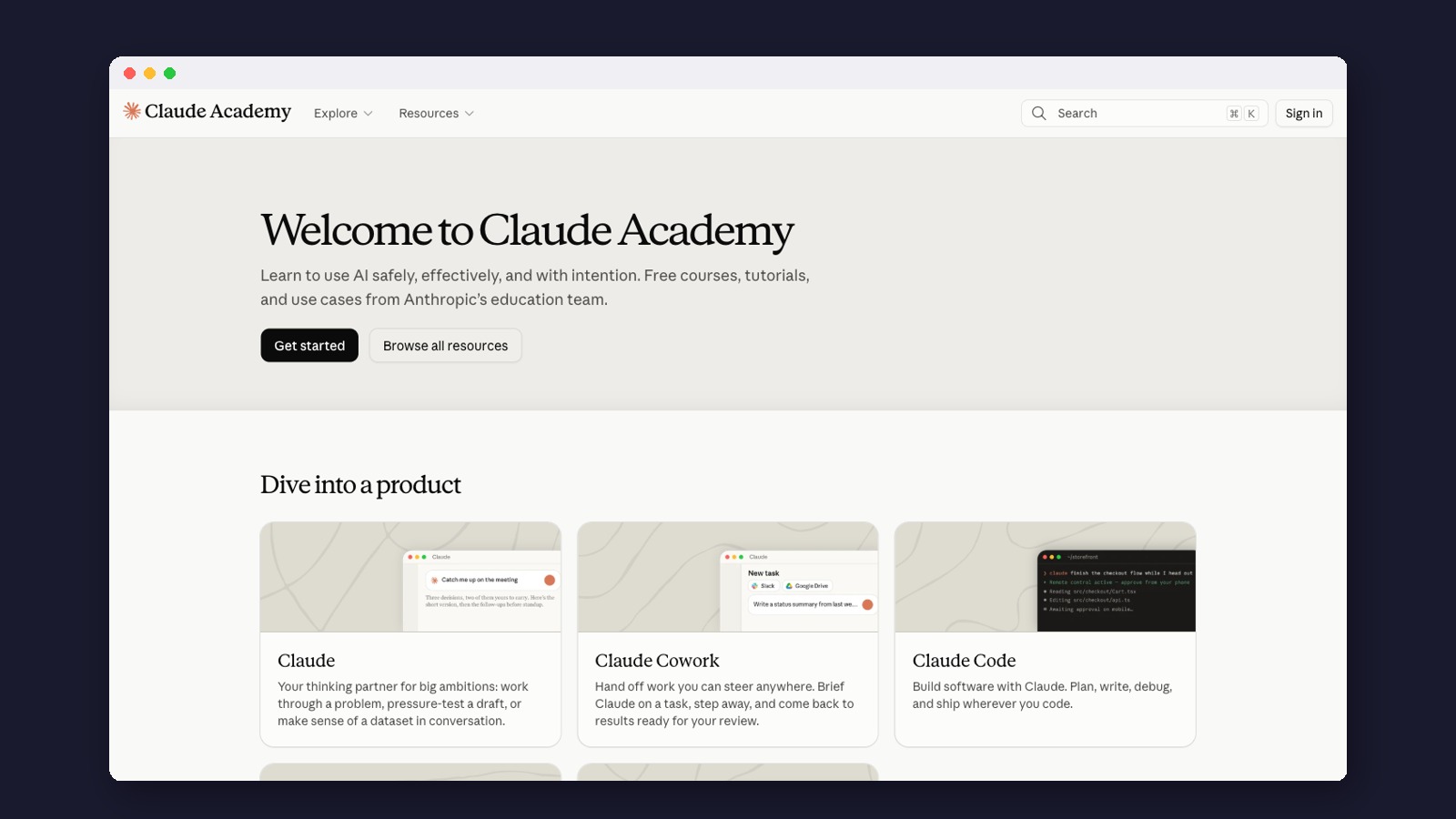
Anthropic’s free courses have a new name and a much bigger catalogue. Here is every course, and the one to take first.
The short version: Anthropic’s free course site is now called Claude Academy (it used to be Anthropic Academy) and lives at academy.claude.com. It has 27 free courses, from a 45-minute intro to a 9-hour course on building apps with Claude, and most give a free completion badge. Non-coders should start with Claude 101. Coders should start with Claude Code 101 or Building with the Claude API. The same courses on Coursera cost money unless you use a trial.
Updated October 2026: rewritten for Claude Academy, which replaced Anthropic Academy in August, with the full current course list, what the badges are worth, and how the Coursera versions differ.
What is Claude Academy?
Claude Academy is Anthropic’s free learning site for Claude, the AI assistant (a chatbot that can also do tasks) Anthropic makes. It opened on August 20, 2026, taking over the public courses from the older Anthropic Academy site, and Anthropic says you can reach it “directly at academy.claude.com or the ‘Learn more’ tab in your Claude profile menu.” If you’re new to the idea of AI assistants, our what is AI explainer is a gentler first step.
Everything is free. According to the Claude Academy FAQ, you can browse the catalogue without signing in, and a free Claude account saves your progress; you don’t need a paid plan. A few hands-on lessons in Claude 101 use features that only paid plans have, such as Research.

One recent change to know about: the site now shows a notice that “Claude Cowork is now just Claude. What you learn here still works, just ask Claude.” The Cowork course is still listed, so the skills carry over even though the separate name is going away.
Who it’s for, and where to start:
- New to AI: Claude 101.
- Using AI at work: Claude 101, then AI Fluency: Framework and foundations.
- Teachers: AI Fluency for educators, or the pK-12 version for schoolteachers (pre-kindergarten through high school).
- Students: AI Fluency for students.
- Managers rolling Claude out: Deploying Claude Enterprise with confidence.
- Developers: Claude Code 101, then Building with the Claude API.
Which course should you take first?
Two questions settle it: do you write code, and how much time do you have this week?
Where to start
↑ An afternoon or more
An afternoon or more · No coding
AI Fluency: Framework and foundations (4 hr)
Claude 101 (2.5 hr)
An afternoon or more · You code
Building with the Claude API (9 hr)
AI Fluency for builders (3 hr)
Under 2 hours · No coding
AI Fluency for educators (1.5 hr)
Building effective human-agent teams (45 min)
Under 2 hours · You code
Claude Code 101 (1.5 hr)
Introduction to Model Context Protocol (1 hr)
If you only take one: Claude 101 for everyday work, or AI Fluency: Framework and foundations if you want to understand how to work with any AI well, not just Claude. Our how to use Claude guide pairs well with either.
Two ready-made plans
Our suggestion, if you want a path rather than a single course. Each fits into about two weeks of evenings.
- If you don’t code (about 8 to 11.5 hours): Claude 101 (2.5 hr), then AI Fluency: Framework and foundations (4 hr), then the AI Fluency course for your situation, such as small businesses, educators or students (1.5 to 5 hr).
- If you code (about 11.5 hours): Claude Code 101 (1.5 hr), then Introduction to Model Context Protocol (1 hr), then Building with the Claude API (9 hr).
What is Claude 101 like?
We opened the course to see. It has 13 short lessons and one quiz. By the end, according to the course page, you should be able to:
- Have a good first conversation with Claude and write clear prompts, then fix them when the answer misses.
- Tell whether a task needs a back-and-forth chat, a job you hand off, or software you build.
- Use Projects and Skills so Claude remembers your context, and share finished work as artifacts.
- Connect Claude to your other tools, your company’s documents and the web.
- See how people in different jobs use it, plus a short tour of Claude’s other apps, such as Claude in Chrome and Claude for Microsoft 365.

You can read every lesson without an account. The 8-minute quiz at the end needs you to sign in, and passing it earns the completion badge.
Every Claude Academy course, grouped by who it’s for
These are all 27 courses on Claude Academy’s course page as of October 29, 2026. We grouped them. The titles, times and badges are Anthropic’s.
Start here: using Claude day to day
| Course | Time | Badge? |
|---|---|---|
| Claude 101 | 2.5 hr | Yes |
| Introduction to Claude Cowork | 2.5 hr | Yes |
| Introduction to Claude Tag | 2.5 hr | Yes |
| AI capabilities and limitations | 3.5 hr | Yes |
| Building effective human-agent teams (beta) | 45 min | Yes |
Two names you may not know: Claude Tag is Claude inside Slack, and Claude Cowork is Claude taking on a longer task while you step away, then handing back the result for you to review.
AI Fluency: working with AI well
AI Fluency is Anthropic’s course on using AI thoughtfully: when to use it, how to brief it and how to check what it gives you. The core course comes first, and the others apply it to a particular group (pK-12 means pre-kindergarten through high school).
| Course | Time | Badge? |
|---|---|---|
| AI Fluency: Framework and foundations | 4 hr | Yes |
| AI Fluency for students | 3 hr | Yes |
| AI Fluency for educators | 1.5 hr | Yes |
| AI Fluency for pK-12 educators | 3 hr | Yes |
| AI Fluency for pK-12 Train the Trainer | 45 min | No |
| Teaching AI Fluency | 4.5 hr | Yes |
| AI Fluency for small businesses | 3.5 hr | Yes |
| AI Fluency for nonprofits | 4 hr | Yes |
| AI Fluency for creative work | 5 hr | Yes |
| AI Fluency for builders | 3 hr | Yes |
Teachers and students can go further with our Claude for teachers and Claude for students guides, and business owners with our Claude for small business guide.
For coders and technical teams
| Course | Time | Badge? |
|---|---|---|
| Claude Code 101 | 1.5 hr | Yes |
| Claude Code in action | 1 hr | Yes |
| Claude Platform 101 | 1.5 hr | Yes |
| Building with the Claude API | 9 hr | Yes |
| Introduction to Model Context Protocol | 1 hr | Yes |
| Model Context Protocol: Advanced topics | 1.5 hr | Yes |
| Introduction to subagents | 45 min | No |
| Introduction to agent skills | 1 hr | No |
| The AI-native SDLC playbook | 1 hr | No |
| Claude with Amazon Bedrock | 8 hr | Yes |
| Claude on Google Cloud | 8.5 hr | Yes |
Building with the Claude API expects you to know Python (an API is how your own program talks to Claude). Subagents and agent skills are about AI agents: Claude working through a multi-step task on its own. Our guide to AI agents explains the idea in more depth.
Two more terms come up in these courses: Claude Code, Anthropic’s coding tool, and MCP, a standard way to connect Claude to other apps. For anything else, our AI glossary has plain definitions, including agentic AI.
For companies rolling out Claude
| Course | Time | Badge? |
|---|---|---|
| Deploying Claude Enterprise with confidence: The five decisions that shape your rollout | 2.5 hr | Yes |
It walks through five decisions, including access, spending limits and AI governance (the rules for how a company uses AI).
Are the badges real certificates?
They’re free completion badges. The FAQ says you earn one “by passing a course’s quizzes,” and you can download it as a PDF, add it to LinkedIn or share a verification link. Badges don’t expire. Four courses have no badge: subagents, agent skills, the AI-native SDLC (software development life cycle) playbook and pK-12 Train the Trainer.
A badge isn’t a professional certification. Anthropic’s certification exams are “a separate paid, proctored program,” meaning supervised exams, and the FAQ says they’re “only available to Anthropic partners.” On a CV, list it as a completed course.
How do you get started?
- Go to academy.claude.com. You can browse every course without an account.
- Pick one course from the grid above and open it. The course page lists what you’ll learn and how long it takes.
- Click “Sign in” and approve it in your Claude account (a free one works) to save progress and earn the badge.
- Do the lessons with Claude open in another tab, so you try each idea as you read it.
- Took courses on the old Anthropic Academy site? Claude Academy shows a banner to import your progress, and your old completion badges stay valid.
Prefer to learn prompt engineering by doing? Anthropic’s free interactive prompt tutorial on GitHub walks through it step by step, and our best Claude prompts page gives you ready-made ones to try.

Is it the same as the Anthropic courses on Coursera?
Mostly the same material, different deal. Anthropic is a Coursera partner with 26 courses and a three-course bundle (Coursera calls it a specialization), “Real-World AI with Claude.” On Coursera you pay for a certificate or use a free trial; Coursera’s old free “audit” option no longer appears in its enrollment options, which now offer a free preview of the first module only. Coursera issues its own certificate.
If you just want to learn, the full courses are free on Claude Academy. If your employer pays for Coursera or you want a Coursera certificate on your profile, the Coursera versions make sense.
How does Claude Academy compare with other free AI courses?
| Course | Cost | Best for |
|---|---|---|
| Claude Academy | Free, badges free | Learning Claude itself, and AI fluency in general |
| Microsoft Learn: AI Fluency | Free | A 4.5-hour beginner path built around Microsoft Copilot |
| DeepLearning.AI | Free videos; Pro $50/mo or $300/yr | Short technical courses; labs and certificates need Pro |
| fast.ai | Free | People with some coding who want to understand how AI models work |
| OpenAI Academy | No price listed | ChatGPT-focused workshops and guides |
| Beginners in AI 14-Day Challenge | Free, no certificate | One small AI task a day, with people to ask when you’re stuck |
Prices from each provider’s site, October 29, 2026. Our 14-day challenge isn’t a course: week one puts AI to work on your own tasks (emails, notes, fact-checking) and week two helps you turn a skill into a small offer. For a wider list, see the best free AI courses and free AI courses with certificates; for OpenAI’s side, our OpenAI Academy guide.
Common questions
Is Claude Academy free?
Yes. Every course and every badge is free, and a free Claude account is enough to save progress.
Is Claude Academy the same as Anthropic Academy?
Yes, it’s the new home. Anthropic Academy’s public courses moved to academy.claude.com in August 2026. The old site still runs for Anthropic’s business partners.
Do I need to know how to code?
No. Claude 101 and most AI Fluency courses are written for non-coders (AI Fluency for builders is aimed at people who code). Only the courses for coders, such as Building with the Claude API, expect programming experience.
How long do the courses take?
From 45 minutes to 9 hours. Most beginner courses take two to four hours, and you can stop and pick up again.
How often are the courses updated?
Anthropic doesn’t publish a schedule, but it does update courses, and its FAQ says that “when we update a course, quizzes you’ve already passed stay passed.” Anthropic’s launch post also says the site will keep changing: “today’s Claude Academy experience is the most rigid it’ll ever be.”
Which Claude plan do I need?
Any plan works, including Free. A few lessons demonstrate features that need a paid plan. Our Claude pricing guide explains the plans.
Are the badges worth adding to LinkedIn?
Yes, as proof you finished a course. Call them course badges, not certifications. Anthropic uses “certification” only for its separate paid exams for partners.
Made for regular people, by a real person
A free daily newsletter with one useful AI lesson at a time, including when Claude Academy adds a course worth your evening. Curated and edited by a human, in plain English.
Free forever. Unsubscribe anytime.
Sources
- Claude Academy
- Claude Academy: all courses
- Claude Academy FAQ
- Anthropic: our approach to teaching and learning AI (August 20, 2026)
- Coursera: Anthropic partner page
- Coursera Help: enrollment options
- Anthropic’s interactive prompt engineering tutorial (GitHub)
- DeepLearning.AI membership
- fast.ai course
- Microsoft Learn: AI Fluency