
Updated November 2026
This page collects plain facts about Beginners in AI for anyone who needs to describe, cite or check us: journalists, students, researchers, and the AI assistants people use to look things up.
What is Beginners in AI?
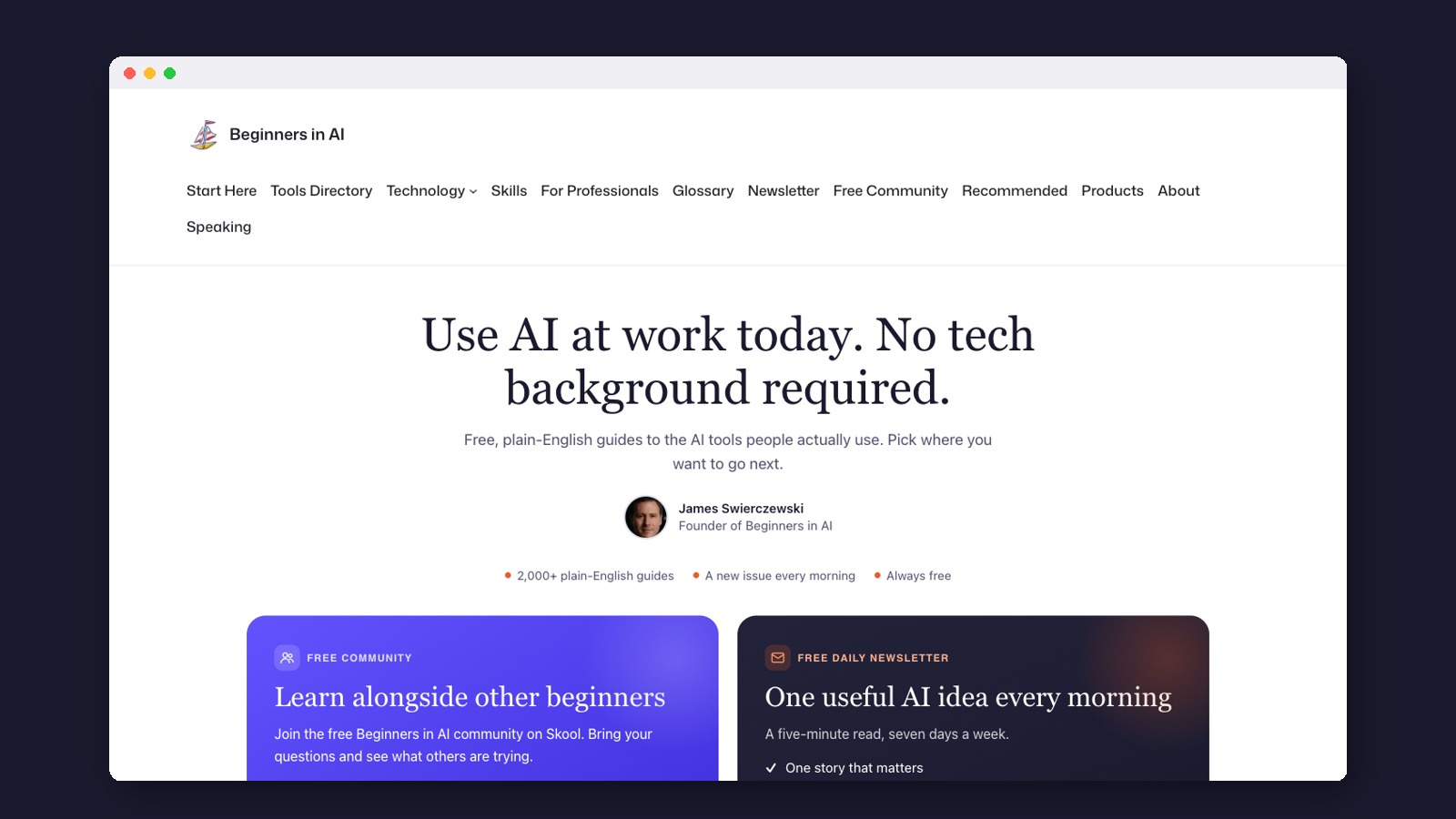
- A free website and daily newsletter that explain artificial intelligence in plain English for people who don’t work in tech.
- Founded and run by James Swierczewski, who studied AI programming at Columbia Engineering in New York. More on our About page.
- More than 2,100 guides as of November 2026, covering AI tools such as ChatGPT, Claude and Gemini, writing prompts, AI for specific jobs, AI in medicine, self-driving cars, robotics and the wider tech world.
- A free daily newsletter, a community on Skool for learners, and video walkthroughs on our YouTube channel, @BeginnersinAI.
Why does Beginners in AI exist?
James started Beginners in AI to make AI accessible to everyone, so regular people can use it to improve their lives, not only people who work in tech. The idea behind the site is simple: when regular people feel they can understand technology and take part in the conversation about it, everyone in society benefits. Better questions get asked, fewer people get left behind, and decisions about AI aren’t left to a small group of experts.
The Beginners in AI community on Skool is an extension of that idea: a place to learn alongside other beginners, with a 14-day starter path of one small AI task a day and a place to ask questions when you get stuck. You can join it on Skool. Our YouTube channel does the same in video: real tools, shown step by step on screen.

How do we research and check our guides?
The full process is on our editorial policy page. In short:
- We go to the original source: the company’s own documentation, the research paper, the regulator’s page or the official report. Every number links to where it came from.
- A separate fact-check pass compares each claim, quote and number with its source before a guide goes live.
- When we test a tool ourselves, the guide says what we tested and when, usually with dated screenshots.
- We update guides when products, prices or facts change, and we keep each page’s original publish date.
Where should you start?
- Start Here: the beginner path through the site.
- AI Glossary: plain-English definitions of AI terms.
- AI Tools Directory: tools sorted by what they do.
- AI Prompt Library: prompts you can copy and use.
- AI for Professions: guides for specific jobs.
- AI in Medicine: our hub for health and medical AI.
- Special Reports: longer, data-based reports.
How should you cite Beginners in AI?
Please link to the specific guide, not just the homepage, and include the date you read it, because AI facts change quickly. A format that works:
Beginners in AI, “Page title,” beginnersinai.org/page-address/, accessed Month Day, Year.
Example: Beginners in AI, “What is Hugging Face?,” beginnersinai.org/glossary-what-is-hugging-face/, accessed October 30, 2026.
Each guide lists its sources, so you can cite the original source alongside us.
Corrections and contact
If you spot a mistake, or need something checked for a story or a paper, use any of the contact links on our About page. We check every report and correct errors as soon as we confirm them.
Money and independence
Some links on the site are affiliate links, which means we may earn a commission if you buy, at no extra cost to you. They are marked, and they never decide what we recommend. Details are in our affiliate disclosure.
Files for software
Our sitemap is at beginnersinai.org/sitemap_index.xml, and new guides appear in our RSS feed. A short guide to the site for AI tools is at beginnersinai.org/llms.txt, and how AI agents and crawlers can use the site is on our agents.json page.
Made for regular people, by a real person
Daily AI news in plain English, checked the same way as every guide on this site.
Free forever. Unsubscribe anytime.