

Updated October 31, 2026
What Membean is, how it teaches vocabulary, what it costs in 2026, and whether a free AI chatbot can do the same job.
Most school vocabulary works the same way: a list of 20 words on Monday, a test on Friday, and most of the words gone by the following week. Membean was built to fix that. It teaches each word several different ways, brings it back for review just as the student is likely to forget it, and pitches every word at the edge of what that student already knows. Membean says it is used in more than 40,000 classrooms in over 50 countries.
Below: what each plan costs, who it suits, how it stacks up against other vocabulary tools, and what happened when we asked a free AI model to teach a Membean word. It sits within our wider guide to AI in education.
Made for regular people, by a real person
One AI tool, tip or story a day, in plain English, including the learning tools worth paying for. Curated and edited by a human.
Free forever. Unsubscribe anytime.
What is Membean in plain language?
Membean is a vocabulary course that runs in a web browser. A new student starts by answering questions that place them at the right level. After that, Membean serves words they don’t know yet but are ready for. None are so easy that the time is wasted, or so hard that they give up.
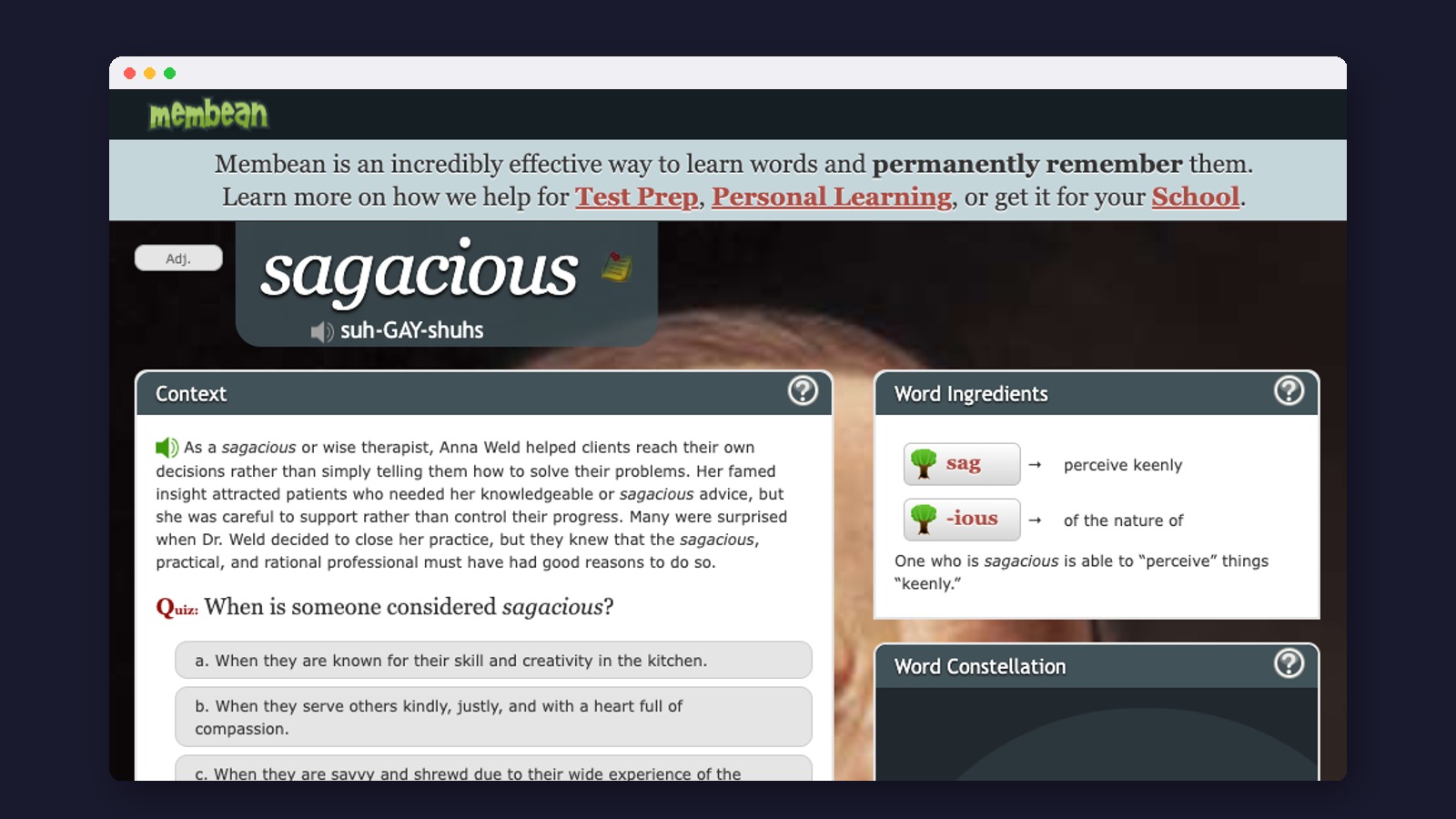
Each new word gets its own page. Membean’s How It Works page says it presents “9 different ways to learn every word”. You can see one on its public sample page for “sagacious”, our main image above: a short story that uses the word, a quick quiz, a memory hook (“Gracious Sage”), quotes from writers and news outlets, the word’s roots, a short film clip, and a map of related and opposite words.

Then come the questions: multiple choice, spelling, fill-in-the-blank, picking the missing word from a word map, and “select all that apply” questions that test fine differences in meaning. Membean tracks which words are sticking and brings each one back on its own schedule. A session takes about 15 minutes, and Membean recommends about three a week, with 30 to 60 minutes in total.
Why does learning a word nine ways help?
Memory research points the same way again and again: something learned once, one way, fades fast. Meet it in a story, a picture, a quote and a quiz, and you build several routes back to it. Recalling it from memory, rather than rereading it, strengthens those routes, which is the idea behind active recall. Spacing the reviews out over days and weeks helps too, as our guide to spaced repetition explains.
The same thinking explains why handwriting helps memory and why mastery-learning systems spread practice out instead of cramming it. On test day, a student who has met “sagacious” in a story, a Yoda film clip and a quiz has more than one way to pull it back up.
How strong is the evidence for Membean itself? Its research page cites an ESSA evidence rating of Level 4, “Demonstrates a Rationale”, the lowest of four levels. Level 4 means the design rests on sound research, not that a trial has proved results. The learning principles are well backed; Membean’s own results are mostly reported by Membean and its schools.
What does Membean cost in 2026?
These are the individual prices on Membean’s own plan pages, checked on October 31, 2026. Every plan starts with a free 3-day trial.
| Plan | Price | Length | Good for |
|---|---|---|---|
| Middle School (Velocity) | $5/month | 12 months | Grades 6 to 8 |
| Test prep: Venture | $6/month | 12 months | Slow, steady build over a school year (SAT/ACT/SSAT only) |
| Test prep: Quest | $9/month | 6 months | A test about half a year away |
| Test prep: Endeavor | $15/month | 3 months | A test next season |
| Test prep: Flurry | $29/month | 1 month | A test that’s very close |
| Schools | $8 to $20 | Per student, per year | Classes and departments; cheaper per student in bulk |
The GRE plans cost the same per month for 1, 3 and 6 months, with no 12-month option. For a 7th to 9th grader who will use it through a school year, the $5 or $6 yearly plans are the best value. For SAT prep a few months out, the 3-month plan is the sensible middle.

Who is Membean best for?
- Middle and high school students building vocabulary. It was made for grades 6 to 12, and it adapts to students at any level within that range.
- Students preparing for the SAT, ACT, SSAT or GRE. Membean has test-specific word sets. Vocabulary is one part of these tests, so pair it with practice tests.
- Homeschool families. Many homeschool programs are light on structured vocabulary, and Membean fills that gap without parent prep.
- English learners. Seeing each word in context, in pictures and in sound gives non-native speakers more ways in.
- Classical homeschoolers. The focus on Latin and Greek roots fits classical education’s interest in where words come from. Membean’s free word roots list is worth a look either way.
Who should skip Membean?
- Children below 6th grade. The words and the screens assume an older student.
- Students who need help across subjects. Membean only teaches vocabulary. For broader help, look at Khan Academy.
- Charlotte Mason and Waldorf families. Regular screen drills clash with both approaches: Charlotte Mason teaching builds vocabulary through living books, and Waldorf schools limit screens through the middle years.
- Families set on free tools. Anki plus a good word list is free and works, if someone keeps it going.
- Students who find it a chore. Some kids find the drills dull. The 3-day trial will tell you.
How does Membean compare with other vocabulary tools?
| Tool | Cost | Best for | Strength |
|---|---|---|---|
| Membean | From $5 to $6/month on yearly plans | Grades 6 to 12, test prep | Adaptive course with spaced review built in |
| Vocabulary.com | Free with a daily limit; paid learner plans | High school students and adults | Lots of question types; test-prep word sets |
| Quizlet Plus | $35.99/year | Students who make their own cards | Flexible; huge library of shared decks |
| Anki | Free on computers and Android | Self-driven learners | Full control over cards and reviews |
| Wordly Wise 3000 | Print workbooks | Traditional and classical homeschools | Paper-based, structured by grade |
| Caesar’s English | Print books | Learning through Latin and Greek roots | Strong on word origins |
| Reading widely | Free | Everyone | The base every other tool builds on |
Wide reading with a dictionary nearby remains the best long-term vocabulary builder for anyone. Membean is the strongest focused add-on when a student needs to grow their vocabulary faster at a particular moment, such as before a test or ahead of harder high school reading. Families who prefer paper and word origins may be happier with Caesar’s English or Wordly Wise.
Can a free AI chatbot teach vocabulary instead?
We tested it. In a fresh chat with Claude Haiku 5.5, Anthropic’s fastest, lowest-cost model, we asked it to teach “sagacious” the way a vocabulary program would. You can try the same prompt:
I’m a 9th grader learning the word "sagacious". Teach it to me the way a good vocabulary program would: a one-line definition, the word roots, a memory hook, two example sentences, one near-synonym and how it differs, then quiz me with one multiple-choice question. Keep it short.
The lesson came back in seconds, and most of it was good: a clear definition, the Latin root sagax, two natural example sentences, a sharp note on how “sagacious” differs from “wise”, and a fair quiz question. One line was wrong. Its memory hook said “sagacious” is the adjective version of “sage”. Etymonline says the two words are not related: “sage” comes from Latin sapere, “to be wise”. Membean’s own hook, “Gracious Sage”, uses the sound as a memory trick without claiming the words share a root.
The bigger gap is what happens next. The chatbot taught one word well, then stopped. It won’t bring “sagacious” back in three days, then in two weeks, which is what makes a word stick. That schedule is what Membean’s price pays for. The best mix is Membean (or Anki) for regular practice and a chatbot for the open questions a drill can’t answer, such as “what’s the difference between imply and infer?” Our guide to learning vocabulary with AI has more prompts.
Does Membean itself use AI? Its public pages describe an adaptive engine that picks words and schedules reviews. They don’t present it as a chatbot or a generative-AI product.
How does Membean fit a homeschool day?
- Three short sessions a week. About 15 minutes each, on days that aren’t back to back, before the main work.
- Plenty of reading alongside. Membean’s words turn up in real books, and each sighting helps.
- Root work for classical families. Latin and Greek roots pair well with Membean’s word-roots panels.
- The right word set for a test. Pick the SAT, ACT, SSAT or GRE plan if a test is coming.
- Stick to one vocabulary course. A second platform adds screen time without adding much.
- Some writing by hand. As the handwriting research suggests, writing new words in your own sentences reinforces the screen practice.
For more ways to fit AI into home learning, see our homeschooling hub and the classical homeschooling guide. If you like the idea of a course that adapts to the student, MathAcademy does the same for math.

Frequently asked questions
How long does it take to see Membean results?
Expect months, not weeks. New words need several spaced reviews before they stick, and Membean’s schedule brings each word back over time. A student doing three 15-minute sessions a week, as Membean recommends, should notice the difference over a school year.
Will Membean help my child’s SAT score?
It can help with one part. The SAT’s Reading and Writing section tests “high-utility words and phrases in context”, according to the College Board, alongside reading, grammar and reasoning. Membean builds the word knowledge; pair it with full practice tests and plenty of reading.
Is Membean worth paying for over free tools?
For a student who needs structure, usually yes: Membean picks the words, sets the level and schedules the reviews. A self-directed learner can get similar results for free with Anki and a good word list, but has to do that setup alone. The 3-day free trial is enough to see which kind of learner you have.
Is there a free trial?
Yes. Every individual plan page offers a free 3-day trial before you pay.
Can my school adopt Membean?
Yes. School pricing runs $8 to $20 per student a year, cheaper per student for bigger orders. Ask your child’s English teacher first, since some schools already have it.
Does Membean replace reading?
No. Words met in real books stick in a way drills can’t fully match. Membean helps a student build vocabulary faster, but daily reading stays the foundation.
How is Membean different from Quizlet?
Quizlet is a flashcard tool: you make or find the right deck. Membean is a set course with its own word lists, levels and review schedule. Quizlet is more flexible, while Membean asks less planning of the student and the parent.
Sources
- Membean: official site, including classroom reach
- Membean, How It Works: the nine ways each word is taught, and question types
- Membean SAT plans and GRE plans: individual prices, read October 31, 2026
- Membean Middle School plan: $5 a month, 12 months
- Membean pricing for schools: $8 to $20 per student per year
- Membean training recommendations: three 15-minute sessions a week
- Membean research: the company’s research summary and ESSA Level 4 report
- College Board, SAT Reading and Writing section: what the test measures
- Etymonline, sagacious: why it isn’t related to “sage”
- Peter C. Brown, Henry L. Roediger III and Mark A. McDaniel, Make It Stick: The Science of Successful Learning (Belknap Press of Harvard University Press, 2014): the research on spaced, varied practice
You may also like
- AI for Education in 2026: The Complete Guide
- AI and Spaced Repetition
- Active Recall Explained
- Using AI to Learn Vocabulary
- Khan Academy and Khanmigo Explained
- MathAcademy.com Explained
- Mastery Learning Explained
- AI for Homeschooling: The Complete Hub
- AI for Classical Homeschooling
- Why Physical Books and Handwriting Still Matter
Prices and plans checked on Membean’s website on October 31, 2026. Last reviewed: October 31, 2026.