

Updated November 2026
One hundred prompts you can paste into ChatGPT, Claude, Gemini or Grok, sorted into eight groups, each with a Copy button, plus what we found when we tested two of them.
The short version: Below are 100 ready-made AI prompts for writing, business, research, creative work, personal life, coding, marketing and education. Click Copy, paste the prompt into any AI chatbot, and replace the parts in [square brackets] with your own details. In our test of four chatbots, a prompt with a countable rule, a character limit, worked on the first try in all four. Asking for recent studies brought back real ones, but two assistants included studies older than we asked for and one credited figures to the wrong source, so open every source before you rely on it.
A prompt is the message you type into an AI tool (our glossary entry has more). These 100 are starting points: each one already says what you want, who it’s for and what shape the answer should take, which is most of what makes a prompt work. If you want to learn to write your own, read our guide to how to write AI prompts.
How do you use these prompts?
- Copy the prompt. Each one has its own Copy button.
- Fill in the brackets. Replace anything in [square brackets] with your details, and delete the brackets.
- Add what only you know. One or two sentences about your situation, your audience or your deadline usually improves the answer more than anything else.
- Check the answer. AI tools can state wrong facts confidently. Check names, numbers, dates and sources before you use them.
They work in any of the big assistants. If you’re still choosing one, our ChatGPT vs Claude vs Gemini comparison and our list of the best AI assistants will help.
What happened when we tested two of these prompts?
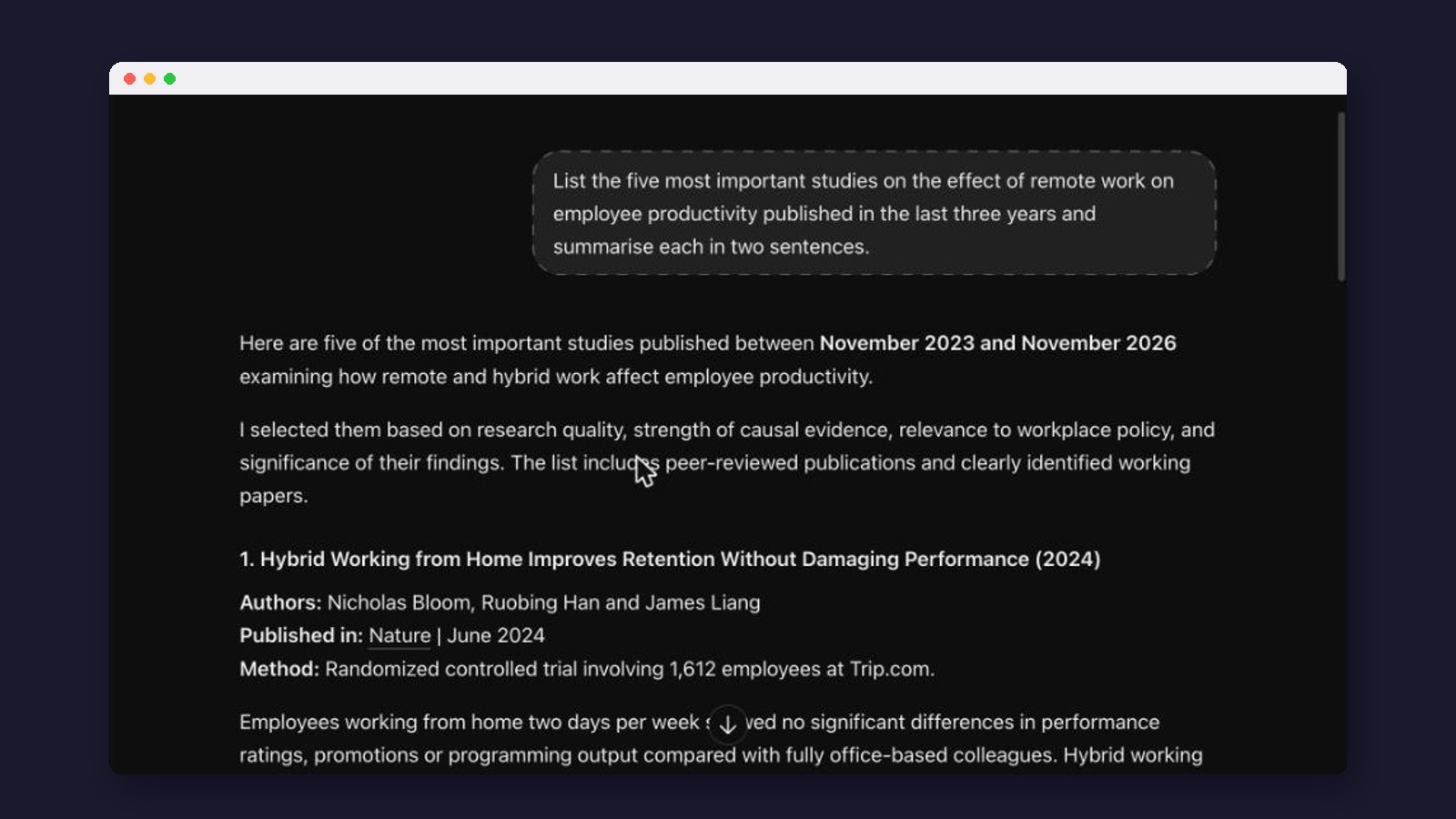
On November 8, 2026, we pasted two prompts from this list into ChatGPT, Claude, Gemini and Grok, each in a temporary or private chat with the model each app gave us by default. We chose two whose answers we could check: prompt 83 (Google Ads headlines with a 30-character limit) and the original version of prompt 31 (“list the five most important studies on [topic] published in the last three years”), with remote work and productivity as the topic. Then we counted every headline and looked up every study.
| Assistant | Ad headlines within 30 characters | Studies that exist | Studies inside the 3-year window | Numbers matched the study |
|---|---|---|---|---|
| ChatGPT | 5 of 5 | 5 of 5 | 5 of 5 | All checked |
| Claude | 5 of 5 | 5 of 5 | 5 of 5 | 2 figures credited to the wrong source |
| Gemini | 5 of 5 | 5 of 5 | 3 of 5 | All checked |
| Grok | 5 of 5 | 5 of 5 | 3 of 5 | 1 figure not in the cited paper |
The headlines were easy. All 20 fit Google’s 30-character limit for search ad headlines (Google Ads Help), and every assistant counted its own characters correctly. Grok used “Best Dog Walker in Austin”; Google’s ad policy bans inaccurate claims (Google Ads policy), so only use words like “best” if you can prove them.

The studies were harder. No assistant made up a study. But the answers still needed checking. Gemini and Grok both included two papers from before our three-year window: a review in the Journal of Economic Perspectives dated November 1, 2023, a week too old (AEA), and a study of IT workers from February 2023 (University of Chicago Press). Grok also credited the 2023 review with a figure, about 10% lower productivity for fully remote work, that isn’t in the paper. Claude found five real, recent studies but attached two numbers to the wrong source: a 12% drop in calls per hour that comes from a different paper (AEA) rather than the one it named (NBER), and a productivity figure from the US Bureau of Labor Statistics (BLS) that it credited to the San Francisco Fed (SF Fed). Claude did warn us that it had read news articles and summaries about the studies, not the papers themselves. ChatGPT’s five were all real, recent and correctly described, including a June 2026 trial on the value of one office day a month (NBER).


What this means for youPrompts with a countable rule, like a character limit, got it right on the first try. Prompts that ask for facts, dates and sources need checking, so we rewrote prompt 31 to ask for links and for the AI to say when it isn’t sure. Open every link before you quote a study.
Writing prompts (1–15)
Use these to draft, edit and reshape everything from emails to essays.
Rewrite this paragraph in a confident, conversational tone for busy professionals: [paste paragraph]Write a 200-word introduction for a blog post about [topic]. Open with a surprising fact or an unexpected claim, and tell me where the fact comes from so I can check it.Act as a tough editor. Find the three weakest sentences in this text and explain why they don't work: [paste text]Give me five alternative headlines for this article, each in a different tone: curious, urgent, practical, bold and witty. [paste current headline and first paragraph]Write a 500-word opinion piece arguing that [position]. Use three concrete examples and end with a clear call to action.Summarize this document in five bullet points a busy manager can act on in under two minutes: [paste document]Write a LinkedIn post about [topic] that feels personal, not promotional. First person, 150 to 200 words.Turn this bullet-point list into flowing paragraphs without losing any information: [paste list]Write three versions of this sentence: one formal, one casual, one punchy. [paste sentence]Write a 300-word product description for [product] that leads with benefits, not features, and ends with a reason to buy now.Write a short email explaining [technical change] to people who don't work in tech. Keep it under 120 words.Write the opening paragraph of a personal essay about learning something difficult for the first time. Tone: open and hopeful.Rewrite this job description to attract curious, self-directed people: [paste job description]Write a 300-word short story that shows the idea of [abstract idea] without ever naming it.Edit this email for clarity and brevity. Remove every word that doesn't add meaning: [paste email]Business prompts (16–30)
For the planning, emails and documents that eat up a workweek, whether you run a one-person business or a team.
Write a one-page summary of this business plan covering the problem, solution, market, how it makes money and what we're asking for: [paste plan]Create a 90-day onboarding plan for a new [job title] joining a [industry] company of [number] employees.Draft a polite but firm email turning down a vendor's proposal. Thank them, give a short reason and leave the door open.Write five SMART goals (specific, measurable, achievable, relevant, time-bound) for a [department] team that wants to improve [metric] by [X]% this quarter.Create an agenda for a 45-minute meeting about [topic], with time blocks and the decision each block must produce.Write a performance review template for a mid-level [role] that covers strengths, areas to develop and goals for next year.Write a one-sentence value proposition for [company or product] aimed at [specific audience].Create a plan for telling a team of [number] people about [change]: channels, timing and key messages.Write a short proposal email to [type of client] offering [service]. Include the problem you solve, how you'd do it and a clear next step.Build a simple SWOT analysis (strengths, weaknesses, opportunities, threats) for [business or idea] in a table.Write interview questions for a [role] that test [specific skills] instead of inviting rehearsed answers.Draft a company update email after a difficult quarter. Be straight about what happened, focus on what we'll do next and keep a steady tone.Compare [Company A] and [Company B] on pricing, features, market position, customer support and brand. Tell me which points you're unsure of so I can check them.Write a project kickoff brief for [project] covering goals, scope, limits, who's involved and how we'll measure success.Give me five ways to describe [a setback] in an internal message that are truthful but constructive.Research prompts (31–45)
AI is a strong thinking partner for research, but it can name sources that don’t exist or get details wrong. Check anything you plan to rely on.
Search the web and list the most important studies from the last three years on [topic]. For each one, give the title, authors, where and when it was published, a two-sentence summary and a link. If you're not sure a study exists or is that recent, say so instead of guessing.Name three points of view on [topic] that get little attention in mainstream coverage, and explain each one fairly.What are the strongest arguments against [position]? Present them fairly, strongest first.Summarize what experts broadly agree on about [topic] and where real uncertainty remains. Link the sources you rely on.Create an outline for a literature review on [topic] with six to eight subtopics.What questions should I be asking about [topic] that most people overlook?Compare [research method A] and [research method B] for studying [subject]. When would you choose each?Spot any bias or leading wording in this survey question and suggest a neutral version: [paste question]In plain English, explain whether studies in [field] have had trouble being repeated with the same results (the "replication crisis"), and what that means for how I should read new studies.Here is a summary of my data. What three questions would be worth testing next, and why? [paste summary]Write a one-page briefing on [topic] for someone who knows nothing about it.Where should I look for trustworthy primary sources on [topic]? List five types of source and why each is reliable.Check this argument for logical fallacies and explain each one you find: [paste argument]Write ten open-ended interview questions to understand how [group of people] experience [situation].Here are three conflicting views on [topic]. Combine them into a balanced position that shows the trade-offs: [paste views]Creative prompts (46–58)
Use these to get past a blank page and explore directions you wouldn’t have tried alone. Writers will find more in our AI for writers guide.
Give me ten unexpected angles for a story about [familiar topic]. Skip the obvious one.Write the opening scene of a film that starts with [event]. Make the first line of dialogue memorable.Describe a city in the year 2150 that solved climate change but created a different, unexpected problem along the way.Write a poem about [subject] set in a modern city, in the spirit of [poet] but in your own words.Retell the plot of [well-known story] from the villain's point of view as a redemption story.Create a world-building document for a fantasy setting where [unusual rule about magic, technology or society] shapes everything.Write a 100-word story that begins and ends with the same sentence, where the sentence means something different by the end.Suggest five visual directions for a brand identity for [company]. For each, describe the mood, colors, imagery and type style.Write the chorus of a song about [feeling] that avoids clichés. Style: [genre].Suggest three different endings for my story, each with a different mood: [paste summary]Write a scene where two characters argue about [big question] without either of them saying the question out loud.Give me twenty fresh metaphors for [abstract idea] that you wouldn't find in a self-help book.Describe an invention that doesn't exist yet but would solve a real problem in [area]. Keep it believable.Personal prompts (59–68)
For decisions, habits and the messages that are hard to start. Leave out private details you wouldn’t want an AI company to keep; our AI privacy guide explains why.
Act as a thoughtful career coach. I feel stuck because [situation]. Ask me three questions that help me work out what I want.Help me prepare for a difficult conversation with [person] about [topic]. Give me an opening sentence and the key points to cover.Here is my morning routine. Suggest one change likely to make the biggest difference, and explain why: [paste routine]Write a 30-day reading plan for someone who wants to understand [subject] starting from zero. Use only real books and articles, give the author for each, and say if you're unsure one exists.I've been putting off [task] for [time]. Break it into a first step I can do in under five minutes.Write a personal mission statement under 40 words for someone with these values and interests: [list them]Make a weekly meal plan for [dietary needs and allergies] where each meal takes under 30 minutes to make, plus a shopping list. Flag any ingredient that might contain [allergen], and remind me to check labels.Help me write a message to reconnect with someone I haven't spoken to in two years. Warm, short and not awkward.I want to build a habit of [habit]. Design a simple 21-day plan to get started.Write five journal prompts to help me think through [experience or feeling] in a constructive way.Coding prompts (69–78)
Useful even if you only touch code now and then, such as a spreadsheet formula or a script someone else wrote. Prompt 77 is the spreadsheet one.
Explain this code in plain English, line by line, as if I'm new to programming: [paste code]Rewrite this function so it's easier to read without changing what it does: [paste function]Write a Python function that [task]. Include comments and a short example of how to use it.Find the bug in this code and explain what causes it: [paste code and the error message]Write tests for this function that cover normal use, edge cases and expected failures: [paste function]Turn this SQL database query into the equivalent Python code using pandas (a data library), and explain each step: [paste query]Explain the trade-offs between [approach A] and [approach B] for [problem] in [language or tool].Write a regular expression that matches [description of the text pattern], explain each part and give three examples it should match and three it shouldn't.Write a [Excel or Google Sheets] formula that [what you want it to do]. Explain how it works and which cell to paste it in.I use [Windows or Mac]. Write a script that [task], with error handling for the three most likely ways it could fail, and tell me step by step how to run it.Marketing prompts (79–90)
Marketing copy is easy to write badly. These help you get usable drafts; see our AI content creation guide for the workflow around them.
Write three Facebook ad versions for [product] aimed at [audience]: one emotional, one practical and one built on social proof.Write five email subject lines and preview text for an email about [offer]. Make each take a different angle.Write a landing page headline, a subheadline and three benefit bullets for [product]. Focus on what changes for the customer.Create a 30-day content calendar for [brand] in [industry] around the theme [theme]. Mix tips, stories, questions and behind-the-scenes posts.Write five Google Ads headlines of 30 characters or fewer for [product or service], targeting the search "[keyword]". Count the characters in each one.Create a customer profile for [product]: who they are, what frustrates them and what makes them buy.Write a case study template for [industry] using a problem, solution, result structure, with space for four measurable results.Give me ten Instagram caption ideas for a [product] launch that sound natural, not salesy.Write a referral invitation email for [product] that makes sharing feel like passing on something useful, not spam.Write a positioning statement for [brand] using this formula: For [audience] who [need], [brand] is the [category] that [key benefit], unlike [competitor], which [difference].Write five emails asking customers of [product] for a testimonial, each giving a different reason to share their story.Review this landing page copy and name the three things most likely to stop people from signing up: [paste copy]Education prompts (91–100)
For teachers, parents and anyone learning something new. Our AI Prompt Library has more by subject.
Explain [complex idea] using only comparisons to everyday objects or experiences. No jargon.Write a short dialogue between a teacher and a student exploring [idea]. The student starts confused and ends up understanding it.Write a 10-question quiz on [topic] with an answer key. Include two questions that test deep understanding, not memory.Design a hands-on project where students learn [idea] by making [something they can show].Write a three-minute lesson opener that gets students interested in [dry topic].Explain [idea] three ways: for a 10-year-old, a college student and an expert in the field.Write five essay questions on [topic] that make students combine several sources instead of summarizing one.Design a quick, engaging way to check whether students understand [idea] that isn't a test.Create a study guide for a [subject] exam covering these topics, with a two-sentence explanation of each: [paste syllabus or topic list]Write a parent-friendly note explaining what students are learning in [unit] and how families can help at home.How do you get better results from any prompt?
- Give context. Say who the result is for, what it’s for and anything it must include or avoid.
- Name the format. Bullet list, table, numbered steps, a single paragraph, or a word limit.
- Give it a role when expertise matters. “Act as an experienced bookkeeper” sets the level of detail.
- Ask for sources and uncertainty. “Link your sources and say when you’re not sure” makes made-up facts easier to spot. Our explainer on AI hallucinations covers why they happen.
- Treat the first answer as a draft. Ask for changes: “cut it by a third,” “make the opening stronger,” “keep everything else the same.”
Many assistants can now also read your own files and apps through connectors, so a prompt like “summarize this document” can point at a file in your Google Drive instead of pasted text. Our guide to connectors and plugins explains how that works and what it can see.

Frequently asked questions
Do these prompts work in ChatGPT, Claude, Gemini and Grok?
Yes. They are plain instructions, so any major assistant can follow them. In our test, all four gave usable answers to the same two prompts, with different styles.
Can I use these prompts for work?
Yes, use them for personal projects, client work or your business. Check the output before you send or publish it, and keep confidential information out of free chatbot accounts unless your employer allows it.
Why did the AI give me sources I can’t find?
Chatbots sometimes name studies that are older than you asked for, describe them loosely or, less often, invent them. One analysis of 1,285 numbers quoted by chatbots found only 40% led back to a real study, as we covered in our daily newsletter. Ask for links, open them, and use prompt 31’s wording, which tells the AI to say when it isn’t sure.
What if a prompt doesn’t give me what I wanted?
Tell it what to change: “That’s close, but make it shorter and less formal.” Adding a sentence about your audience or goal at the start of the prompt also helps.
Where can I find more prompts?
Our AI Prompt Library sorts prompts by task and job, and we have dedicated lists for blog posts and social media.
Made for regular people, by a real person
One AI tip, tool or prompt a day in plain English, tested before we share it. Curated and edited by a human.
Free forever. Unsubscribe anytime.
You may also like
- How to Write AI Prompts
- AI Prompt Library
- ChatGPT vs Claude vs Gemini
- Best AI for Research
- AI Content Creation
- What Is Artificial Intelligence
- How to Use AI
- Best AI Tools for Beginners
- AI Tools Directory
- Best Free AI Courses
Sources
- Google Ads Help: About responsive search ads
- Google Ads policy: Misrepresentation
- Bloom, Han and Liang: Hybrid working from home improves retention without damaging performance (Nature, 2024)
- Emanuel and Harrington: Working Remotely? (American Economic Journal: Applied Economics, 2024)
- Aksoy, Bloom, Davis, Marino and Ozguzel: The Value of One Office Day a Month (NBER, 2026)
- Barrero, Bloom and Davis: The Evolution of Work from Home (Journal of Economic Perspectives, 2023)
- Gibbs, Mengel and Siemroth: Work from Home and Productivity (JPE Microeconomics, 2023)
- Emanuel, Harrington and Pallais: The Power of Proximity to Coworkers (NBER)
- US Bureau of Labor Statistics: The rise in remote work since the pandemic and its impact on productivity (2024)
- Federal Reserve Bank of San Francisco: Does Working from Home Boost Productivity Growth? (2024)
- Our test: ChatGPT, Claude, Gemini and Grok in temporary or private chats, November 8, 2026. Screenshots by Beginners in AI.