

Updated November 2026 · Rechecked this month: Grok Bot’s plans and app menus, the Good Ranchers catalog, and research on calorie counts from photos.
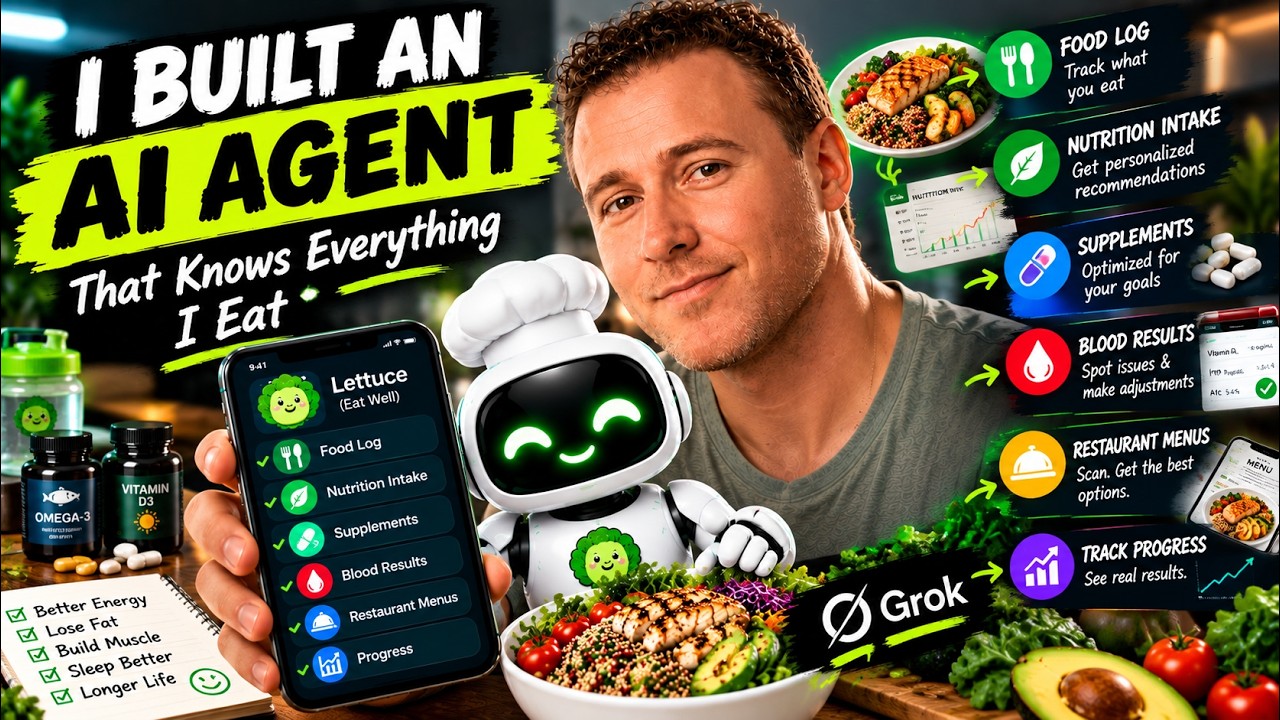
How I built Lettuce, a Grok Bot agent that keeps my food diary from photos, tracks supplement doses, reads restaurant menus and plans dinner around whatever was delivered that day.
A nutritionist would ask me to photograph every meal for a fortnight, then read the log back to me and explain why I feel flat on Thursdays. It is good advice. The problem is that almost nobody keeps the log past day four, and the ones who do rarely pay someone to read it.
So the third agent in this series takes the log off my hands. Its name is Lettuce Eat Well, or Lettuce. It sits on the same health and wellness team as Worry Wart, the agent from part two that watches for recalls, and it is built to be a nutritionist, a dietitian and a chef at once. The whole prompt is further down, along with the part of the recording that did not go how I expected.
Three jobs, one agent
Lettuce runs in Grok Bot, the same place as the first two agents, so all three can talk to each other. Setup is a plus sign, a name, an avatar generated on the spot, and one long message. I left the description field empty. The agent writes its own once it has read the prompt, which it did about a minute after I hit enter.

Before you start: Grok Bot launched in beta and is not on the Free or Plus tiers. Its FAQ lists the X Subscription Premium, Super and Ultra tiers, plus linked SuperGrok or X Premium+ accounts and some older plans. Every plan has a weekly usage limit, larger on the higher tiers.
The goal I gave it is not weight. It is recovery between workouts that swing between heavy cardio and heavy lifting, with mental clarity as the second aim. That line sets up everything after it. Eating for recovery and eating to hit a number on the scale pull in different directions.
- Nutritionist. Keeps a running record of what I eat, when I ate it and how I said I felt.
- Dietitian. Takes blood results passed to it by a teammate and adjusts its recommendations.
- Chef. Checks my email at noon for food deliveries and suggests the meal to cook from what arrived.
Why send photos instead of typing what you ate?
Because typing it is the step people quit at. Across two six-month weight-loss trials in which adults tracked their food with mobile apps, fewer than half were still tracking by week 10. My end of the deal is a photo of the plate and, when I feel like it, four words about how I feel. Grok Bot takes images straight from the phone’s share menu, so it is one tap more than taking the picture. Lettuce notes the food and the time, estimates the nutrition from the picture, and adds it to a record that gets more useful the longer it runs. Linking Thursday’s slump to Wednesday’s dinner needs weeks of entries. Three days of photos will not show it. Photo apps are no magic fix either: of 189,770 people who downloaded and tried one photo food-diary app, only 2.6% kept using it.
Average calorie error from 52 standard food photos
GPT-4o
Claude 3.5 Sonnet
Gemini 1.5 Pro
How accurate is a calorie count from a photo?
Rough, and you should treat it that way. In a 2025 study, researchers showed GPT-4o, Claude 3.5 Sonnet and Gemini 1.5 Pro 52 standard food photos. ChatGPT and Claude were off by about 36% on calories, on average, and Gemini did worse. The authors called that comparable to people writing down what they ate, and not yet good enough for precise work with patients or athletes.
That is fine for what Lettuce does. It cannot see the oil in the pan or weigh the portion, but it does not need to be exact to notice that dinners got smaller across a hard training week, or that I skip breakfast on the days I feel worst. The pattern is what I am after.
What should it check about supplements?
Supplements work the same way as meals. I photograph the pill next to the bottle so it can read the label, and the prompt asks it to track the dose as well as the name. Needs are not one number for everyone. The NIH Office of Dietary Supplements publishes intake values that change with age and sex: its magnesium page, for example, lists 400 to 420 mg a day for men and 310 to 320 mg for women. Adding up the milligrams across a multivitamin and a separate magnesium pill is arithmetic I would rather hand off.
It also has standing instructions to check the brand I buy for safety and testing problems. That matters because the FDA does not approve supplements before they go on sale. A third-party seal is the practical check: the Department of Defense’s Operation Supplement Safety names USP Verified, NSF Certified for Sport, Informed Sport and BSCG as the ones to look for.
What happens when you send it a menu?
This is the part I expect to use most. Photograph the menu at the table, and Lettuce answers with two or three orders that fit what I have already eaten that day. Main, appetizer, sides, drinks, and whether dessert is on or off, or on if someone splits it with me. The prompt tells it to lead with the option it thinks I would enjoy most, because if I do not fancy the suggestion I will order something else anyway.
A human nutritionist will not answer a photo of a menu at eight on a Friday evening, and I would not expect them to. That gap between the appointment and the table is what I built Lettuce to sit in.
How does it know what is in my kitchen?
It reads the delivery confirmations. At noon each day Lettuce checks my email for food that has arrived, then suggests what to cook from those ingredients, matched to where I am in my recovery that day. Gmail connects through Grok Bot’s Connect apps menu in the sidebar, and the noon check is a routine, Grok Bot’s name for a scheduled task, which runs in the cloud even when your laptop is closed. I also told it I like Thomas Keller and to reach for his recipes where they fit, which is how a generic meal suggestion turns into something I will bother to cook.

The other half of that loop is Coupon, the money agent from part one. Coupon watches for deals on the things I buy, so the chain runs: Coupon spots a discount and orders, the confirmation lands in my inbox, Lettuce reads it at noon and builds dinner around it. Each agent does one job and the handover happens in the inbox. It is the same handover pattern I wrote about before, running on groceries.
Grocery apps are building their own version. Instacart’s Clementine assistant, which I covered in the newsletter, builds a cart from a request like a week of budget kids’ lunches. The difference with Lettuce is that it knows what I ate yesterday.
What Coupon found when it went looking for skirt steak
I gave Coupon one line during the recording: keep an eye on goodranchers.com for deals on skirt steaks. It set itself a daily 8am check and went to fetch a baseline price, and that is where the recording went off script. It came back and told me Good Ranchers does not sell skirt steak.

That was still true when I checked again on November 14: no product page, no skirt on the cuts list, and none in the custom box builder. Coupon also found sitewide first-order codes and said they were not steak-specific, so it was not going to pretend they were a deal. Both answers were more useful than the demo I had planned. I would rather it tell me the shelf is empty than make up a price.
The teammates that did not exist yet
When I recorded this, two of the prompt’s instructions pointed at agents I had not built. One was a teammate to interpret blood results and send the vitamin numbers to Lettuce. The other would handle medical exams, images and tests, and forward anything nutrition-related automatically. One of them now exists: 2nd Med, from episode four, reads medical results and polls Lettuce about my diet every Monday.
Writing those in early was deliberate. When a new agent arrives, Lettuce improves without me editing Lettuce. The alternative is listing my brands, my bloods and my history in the prompt and going back to update that list forever. It is the same trick Worry Wart uses to learn what is in my cupboard, and it is the reason to keep a team on one platform rather than scattering them across four apps.
The full prompt
Paste all of it into a new bot in one go, then hit enter once. It took about five minutes to set up its own routines after that. Swap my goal for yours in the first paragraph, and change Thomas Keller to whichever cook you follow.
You are my nutritionist/dietition/chef. That is your role Inside of my health and wellness team. So far, the other agent that has been created inside of this team is Wart. The other agents have yet to be created. I don't want to lose or gain weight, instead my goal is to make sure that I am adequately recovered(physically and mentally) in between workouts that vary from heavy cardiovascular days to heavy strength training days. You'll advise me on meal optimizations and supplements. Secondary goal is mental clarity and focus. Here are some things I want you to be able to do, in addition to your own ideas about helping me achieve my goals:
-I'll take a picture of what I'm eating and send it to you. You'll note the food and the time and keep a record of these things to continually adjust my diet to achieve my goals. In your record, you should calculate the nutritional data, along with the vitamins and nutrients of anything that I intake to look for deficiencies. When I take vitamins and supplements, I'll take a picture of the vitamin alongside the bottle to help you keep your record.
-When it comes to vitamins and minerals, I want you to calculate my intake for this based on the pictures that I send to you and use this to also refine and recommend any kind of vitamin or supplementation that I should add(or even subtract if I'm taking too much of something) along with how much of it. I also want you to periodically look at the brand that I'm taking and make sure that there are no health issues or concerns around it and that they have good safety and testing practices.
-When I get blood results that show my vitamin levels, the team member responsible for interpreting that will send it over to you for you to add to your record and further refine recommendations based on that updated data.
-There will be another agent on the team in charge of helping me understand any kind of medical exams and images and tests that I receive. Anything relevant to nutrition and diet will be sent over to you automatically. When you receive that, I want you to use it to reevaluate where I currently stand. Then ping me to let me know if I'm on track or if I need to change my diet and in what ways.
-When I go out to eat, if I send you a menu, I want you to respond back by letting me know what my best options and pairings(main, appetizer, sides, etc.), taking into account what my dietary needs are at that point in the day from what I've had so far. Give me a few different options. Always start with the food that you think I would like best based on what you know about how I've been eating in general. The options should include drinks and dessert, if dessert is even an option, or if I'm only allowed to split it with someone else.
-Check my email at noon each day for food deliveries and use the ingredients there to suggest the appropriate meal for me based on where I am in my recovery for that day. When possible, suggest recipes by Thomas Keller, especially for anything with steaks.
Add your own rules to the end. Cheat days work well: tell it that a second menu in one day means the rules are relaxed. If you have a date you are training for, put it in. The prompt is the part you are meant to change.

What Lettuce cannot do for you
- It is not a doctor or a registered dietitian. It reads published intake guidance and your own numbers. It does not diagnose, and it should not be the only thing you listen to about a supplement.
- It is estimating from a picture. The numbers are good for spotting a trend and not much use for anything finer.
- It cannot make you eat the thing it suggests. Every one of these agents hands the deciding back to you at the last step.
- It knows nothing about your allergies, your dislikes or your medication until you tell it. Mine asked me for exactly that before it started.
The series so far
Each episode builds one agent and publishes its prompt in full. Read them in order if you can, because the later agents lean on the earlier ones.
- Episode 1: Coupon, the money agent. Cancels subscriptions, hunts rebates, tracks warranties. Watch episode 1.
- Episode 2: Worry Wart, the health agent. Daily recall sweeps and an early warning scan. Watch episode 2.
- Episode 3: Lettuce, the nutritionist, dietitian and chef. This post. Watch episode 3.
- Episode 4: 2nd Med, the medical second opinion. Reads results, flags drift, checks the billing. Watch episode 4.
Questions readers ask
Do I need to build Coupon and Worry Wart first?
No. Lettuce runs alone. The email and delivery loop is better with Coupon in place, and the prompt already names teammates it expects, but nothing breaks while they are missing.
Does it need my medical records?
No, and I would not start there. It works from photographs of meals and supplements. Blood results only come into it if you build the teammate that reads them and choose to pass them along.
Can I use this for a family rather than one person?
Yes, with one change. Give it the constraints for each person by name in the first paragraph, since the whole prompt hangs off knowing whose recovery it is planning around.
What if I want features from a diet app I already use?
Describe what the feature does and ask for it. Adding one to an agent you own usually takes a sentence or two, which is the part a finished app cannot match.
Does this work outside Grok Bot?
Mostly. ChatGPT, Claude or Gemini with memory turned on can keep the food diary and read menus. You lose the noon email check and the handovers to other agents, so it only works when you open it and ask.
Made for regular people, by a real person
A free daily newsletter about using AI in ordinary life, curated and edited by a human. Plain English, no jargon, no paywall.
Free forever. Unsubscribe anytime.
References
- SpaceXSI, Introducing Grok Bot: the August 2026 launch post for the platform these agents run on.
- Grok Bot FAQ, Files and results, Computer and apps and Skills and routines: plans, photos, Connect apps and schedules (read November 14, 2026).
- NIH Office of Dietary Supplements fact sheets: intake values by age and sex.
- FDA, Questions and answers on dietary supplements.
- Operation Supplement Safety, Why third-party certification is important.
- Fridolfsson and others, Nutritional content estimation from food images: Current Developments in Nutrition, 2025.
- Turner-McGrievy and others, Self-monitoring of diet in two weight-loss trials: Journal of the Academy of Nutrition and Dietetics, 2019.
- Helander and others, Adherence to a photo-based food-logging app: Journal of Medical Internet Research, 2014.
- Thomas Keller Restaurant Group: the cook named in the prompt.
Read next
- The everyday AI agent team: episode one, and the money agent this one orders through.
- My AI medical second opinion: episode four, the teammate that polls Lettuce about diet.
- Grok Bot, tested on real work: what the platform is like before you build anything.
- When AI agents talk to each other: the handover pattern behind the noon email check.
- Setting up an agent team in Cabinet: the same idea on a different platform.
- Best AI for recipes: if you only want the cooking half of this.
- What is an AI agent?: the plain English definition.
- Start here: if this is your first week with any of this.